Basics and Overview of Flip Flops
A flip flop is an electronic circuit with two stable states that can be used to store binary data. The stored data can be changed by applying varying inputs. Flip-flops and latches are fundamental building blocks of digital electronics systems used in computers, communications, and many other types of systems. Flip-flops and latches are used as data storage elements. It is the basic storage element in sequential logic. But first let’s clarify the difference between a latch and a flip flop.
Flip flop v/s Latch
The basic difference between a latch and a flip-flop is a gating or clocking mechanism. For example, let us talk about SR latch and SR flip-flops. In this circuit when you Set S as active the output Q would be high and Q’ will be low. This is irrespective of anything else. (This is an active low circuit so active here means low, but for an active high circuit active would mean high)
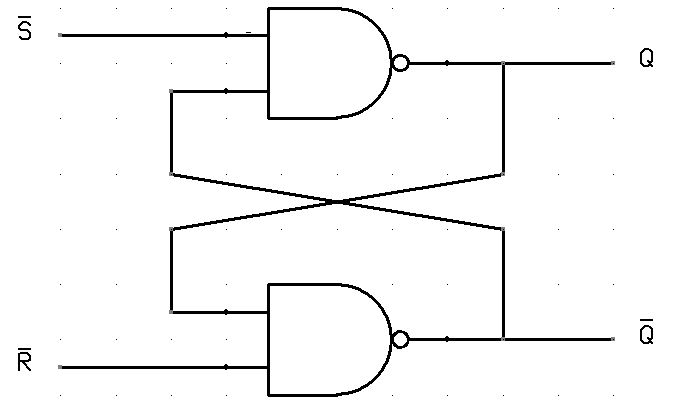
A flip flop on the other hand is synchronous and is also known as gated or clocked SR latch.
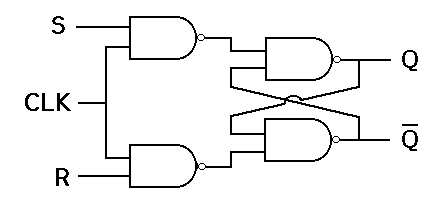
In this circuit, the output is changed (i.e. the stored data is changed) only when you give an active clock signal. Otherwise, even if the S or R is active the data will not change. Let’s look at the types of flip flops to understand better.
SR Flip Flop
There are majorly 4 types of flip flops, with the most common one being SR flip flop. As shown above, it is the simplest and the easiest to understand. The two outputs as shown above are the inverse of each other. The outputs of a SR flip flop are highlighted in the table below.
| S | R | Q | Q’ |
| 0 | 0 | 0 | 1 |
| 0 | 1 | 0 | 1 |
| 1 | 0 | 1 | 0 |
| 1 | 1 | ∞ | ∞ |
JK Flip-flop
Due to the undefined state in the SR flip flop, another is required in electronics. The JK flip flop is a improvement on the SR flip flop where S=R=1 is not a problem.
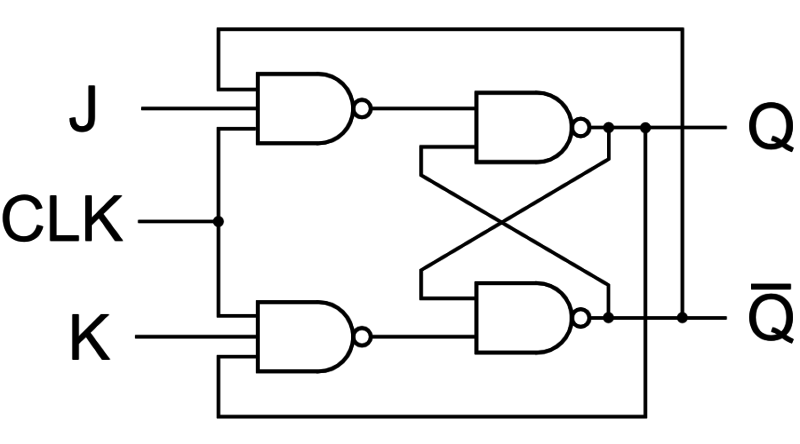
The input condition of J=K=1, gives an output inverting the output state. However, the outputs are same when one tests the circuit practically.
| J | K | Q | Q’ |
| 0 | 0 | 0 | 0 |
| 0 | 1 | 0 | 0 |
| 1 | 0 | 0 | 1 |
| 1 | 1 | 0 | 1 |
| 0 | 0 | 1 | 1 |
| 0 | 1 | 1 | 0 |
| 1 | 0 | 1 | 1 |
| 1 | 1 | 1 | 0 |
D Flip Flop
D flip flop is a better alternative that is very popular with digital electronics. They are commonly used for counters and shift-registers and input synchronization.
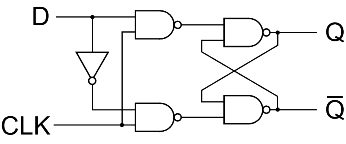
In a D flip flop, the output can be only changed at the clock edge, and if the input changes at other times, the output will be unaffected.
| Clock | D | Q | Q’ |
| ↓ » 0 | 0 | 0 | 1 |
| ↑ » 1 | 0 | 0 | 1 |
| ↓ » 0 | 1 | 0 | 1 |
| ↑ » 1 | 1 | 1 | 0 |
The change of state of the output is dependent on the rising edge of the clock. The output (Q) is same as the input and can only change at the rising edge of the clock.
T Flip Flop
A T flip flops is like JK flip-flop. These are basically single input version of JK flip flops. This modified form of JK flip-flop is obtained by connecting both inputs J and K together. This flip-flop has only one input along with the clock input.
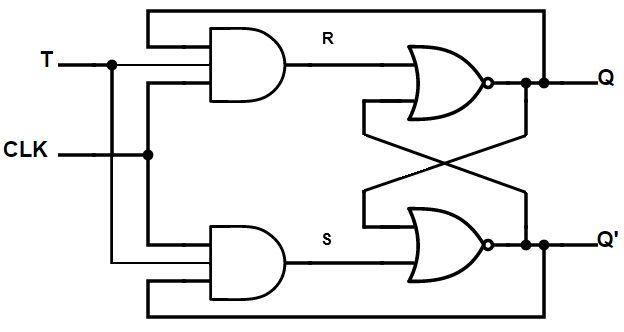
These flip-flops are called T flip-flops because of their ability to complement its state (i.e.) Toggle, hence the name Toggle flip-flop.
| T | Q | Q (t+1) |
| 0 | 0 | 0 |
| 1 | 1 | 1 |
| 0 | 1 | 1 |
| 1 | 1 | 0 |
Applications of Flip-Flops
These are the various types of flip-flops being used in digital electronic circuits and the applications of Flip-flops are as specified below.
- Counters
- Frequency Dividers
- Shift Registers
- Storage Registers
Comments
Post a Comment